
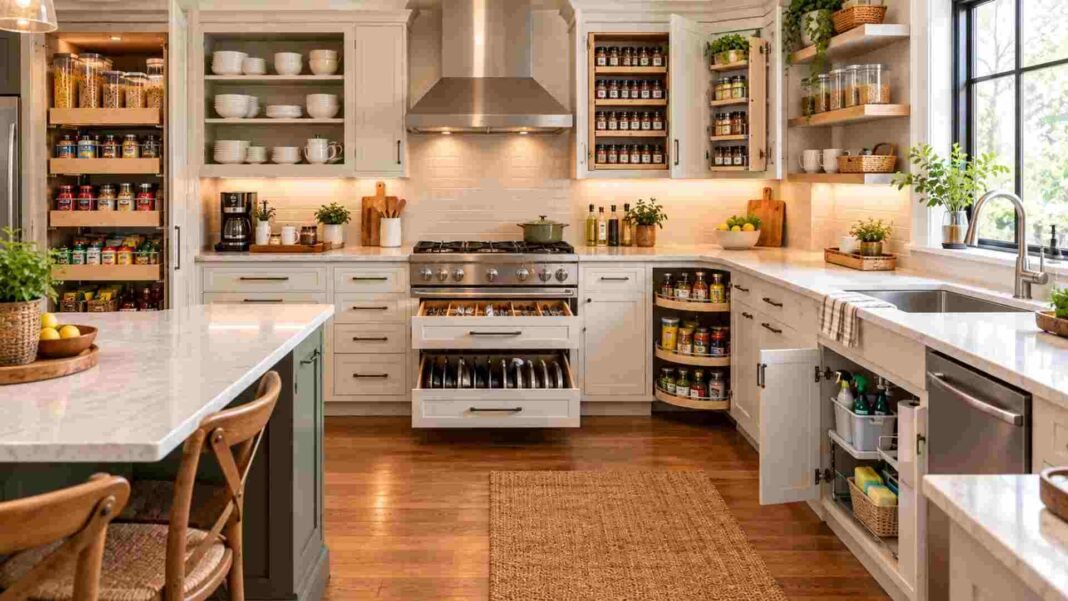
When you open a drawer thing in the morning and find a heap of spoons, peelers, and rubber bands,s it really puts a damper on the day. The issue isn’t that the kitchen is dirty; ty the issue is that items are not where they should be. No matter if the kitchen is tiny or big, this kind of confusion happens in every home at some point. The aim of kitchen organization isn’t just about looking nice; it’s about making daily jobs simpler. When every item has a spot, both the time spent looking and the stress of searching are cut down.
15 Clever Kitchen Organization Ideas Include:
1. Divide Kitchen Drawers
Use drawer dividers to create sections for spoons, knives, and small tools. This keeps everything in its place so you don’t have to dig through the drawer every time. Adjustable dividers work with drawers of all sizes. Put items you use every day at the front, for access. This makes kitchen drawer organization simple and effective.

2. Pull‑Out Pantry Shelves
Deep pantry cabinets often hide forgotten and expired items. Pull‑out pantry shelves let you pull the shelf out for easy access. This is a practical pantry organization idea that keeps everything in sight without bending or reaching. Pull‑out pantry shelves are especially useful in narrow pantries.

3. Label Everything
Labels help everyone in the house understand where something is stored without having to ask. Labeling containers containing flour, sugar, or various grains is the most useful. It is not necessary to label every container, only those items that are really difficult to identify; otherwise, it just becomes extra work.

4. Organize Under the Sink
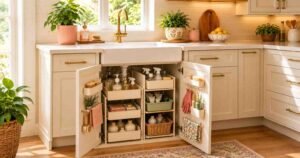
Use bins or tension rods under the sink. These help keep cleaning supplies, sponges,s and reusable bags neat. Keep cleaning chemicals from food items. Keep them out of reach of children. Space around pipes is often wasted. Small adjustable organizers fit best in those spots.
5. Maximize Cabinet Space
Use shelf risers and stackable bins to make the most of the vertical space inside a cabinet. Instead of piling things on top of each other, place each item on its own level so you don’t have to lift the top one to reach the bottom. Simple risers and turntables often bring improvements when organizing cabinets well.
6. Organize by Zone
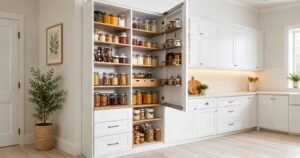
Group items by function, like a cooking zone, a baking zone, a coffee zone, and a cleaning zone. Zones stop you from running for each job and keep everything you need in one spot. Organizing by zone method puts use before looks, which can really be more useful.
7. Tame Corner Cabinets
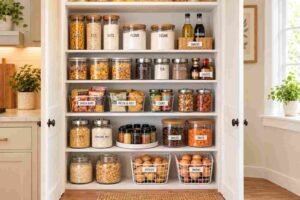
Corner cabinets are often the most cluttered and hard to organize because the items in the back are not visible. Corner cabinet storage can be improved a lot by installing rotating organizers or pull‑out systems. A Lazy Susan is a solution that brings everyday items to the front.

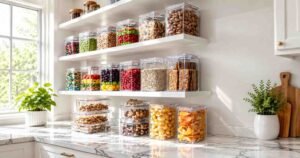
8. Use Clear Containers
Clear pantry containers help you see what is about to expire, which helps avoid buying the same thing again. When you buy containers, think about more than how they look: they need to fit your space and the food you are storing. It is not always smart to buy containers just because they look good together.
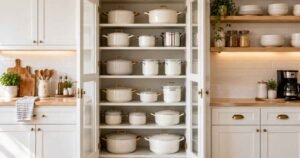
9. Store Pots Vertically
When pots, pans, and lids are stacked horizontally, pots become hard to reach at the bottom. Adding dividers or a pot rack lets each pot be pulled straight out and easily. Pot racks stop the trouble of moving the stack again and again and keep heavy pots safe.
 10. Organize Your Spices
Group spices and get rid of old, duplicate,e or scent-losing bottles. Good spice rack organization relies on visibility, ty as misplaced spices are often hard to find while cooking. Storing them near the stove or in a drawer insert keeps them within reach and in sight.

11. Organize Cabinet Doors
Cabinet Doors work well when you add hooks or small racks. They can hold measuring spoons, cling wraps,s or small cleaning tools. This space is often overlooked. It is perfect for light items. However, you should never hang items on Cabinet Doors because that can put pressure on the hinges and cause damage.

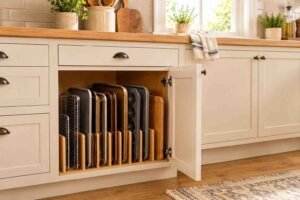
12. Store Baking Sheets Upright
Baking sheets, cutting boards, and trays can be seen easily. Taken out when you keep them upright. Vertical dividers keep these flat items apart so they do not pile together. This method is especially useful for people who bake or roast often.
13. Create a Coffee Station
Create a small coffee or beverage corner where mugs, coffee, tea, and sugar are kept together. A tray is enough in a small kitchen, while a large kitchen can use the kitchen countertop section. This saves time in the morning rush because everything is in one place.

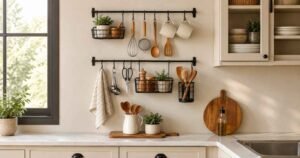
14. Hang Mug and Tools
Wall-mounted hooks or rails can be used to keep mugs and tools that are used often out of cabinets, making space inside the cabinets. Just choose a place that does not get in the way while cooking or cleaning. It is also important to remember the weight limit.
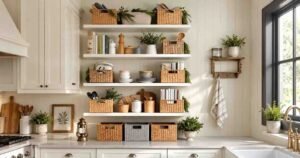
15. Control Clutter with Baskets
Baskets keep items like snack packets or foil rolls together in one place so they do not scatter on shelves. Control Clutter with Baskets by choosing the size for the space where Baskets will sit. Label only if it truly helps with identification; otherwise,e simple Baskets are enough for a clutter-free kitchen.
Common Mistakes To Avoid
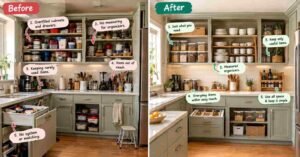
There are a few mistakes when organizing a kitchen that make even a good amount of storage space less useful:
- Overfilling cabinets and drawers: Do not pack items so tightly that they become hard to pull out.
- Buying organizers without measuring: Measure the space before purchasing any organizer.
- Keeping items: Remove items that are rarely used and duplicate others.
- Using containers: Choose containers that’re easy to open and clean.
- Keeping frequently used items out of the way: Place everyday items within easy reach.
- Ignoring space: Use the area above shelves, dividers, and hooks.
- Trying to keep everything matching: Prioritize how it works over how it looks.
- Creating a system: Keep the organization simple so that everyone in the house can maintain it.
Frequently Asked Questions(FAQ’s)
Question #1: What is the best way to start Kitchen Organization?
Answer: Kitchen Organization begins best when you start with one drawer or cabinet. Remove items that you do not need. Then arrange the remaining items based on how you use them.
Question #2: How can Kitchen Organization work in a kitchen?
Answer: Kitchen Organization can thrive in a small kitchen by using vertical space. Hang hooks on the walls. Store items in cabinet spaces. Keep the necessary items on the counters.
Question #3: How often should Kitchen Organization systems be reviewed?
Answer: Kitchen Organization systems need to be checked every month. Re‑check your items, containers, and storage arrangements.
Question #4: What storage products are most useful for Kitchen Organization?
Answer: Kitchen Organization works with drawer dividers, shelf risers, baskets, and vertical organizers. These are usually options.
Question #5: How can Kitchen Organization keep a kitchen clutter-free?
Answer: Kitchen Organization keeps a kitchen clutter-free by giving every item a place. That way you can put items back easily after use.
Final Thoughts
Kitchen organization goes beyond a look. Kitchen organization also helps everyday chores feel lighter. When tools that you use a lot are right where you need them, when cabinets and drawers are ordered, and when every item knows its spot,t the kitchen feels less crowded. Small practical tweaks can make kitchen organization feel more useful, cozier,zy and easier to keep clean for years.
